

The Technical Foundation of Market Integrity
Innovation shapes modern iGaming, with independent certification ensuring compliance, and it thrives in regulated markets.
Today’s iGaming landscape is defined by increasingly sophisticated mechanics, evolving architectures, and data-driven innovations in gameplay. As these advancements accelerate, so does the need for technical certainty behind them. Before a game reaches regulated deployment, its mathematical and payout model must be verified through structured statistical analysis, its logic must perform exactly as designed, and its architecture must align with defined regulatory standards.
Game certification is not merely a checkpoint in that journey, it is the framework that allows innovation to move confidently from development to a regulated reality, ensuring fair play for the players. For developers, suppliers, operators, and aggregators, independent verification provides the confidence, clarity and structure required to scale new ideas across multiple jurisdictions without compromising integrity.
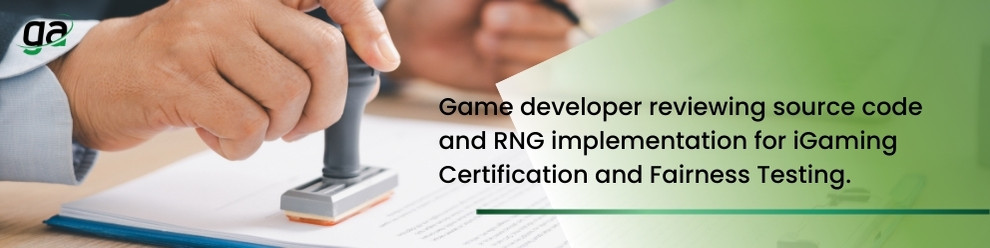
Regulated gaming markets depend on demonstrable integrity. Independent testing laboratories such as Gaming Associates play a central role in validating that games and integrated components operate fairly, securely, and in accordance with defined technical standards. iGaming certifications provide the documented evidence that underpins regulatory oversight and market confidence. Independent testing laboratories are considered an extended arm of the regulators and have gone through the rigorous accreditation and regulatory approval processes.
Structured Compliance Across the iGaming Value Chain
For Game Developers
Certification validates that innovation meets technical and regulatory standards before market entry.
For Suppliers
It enables distribution across multiple regulated jurisdictions while maintaining consistency.
For Operators
It ensures portfolio compliance aligns with licensing conditions and fair payouts for their valuable players.
For Aggregators
It provides assurance that integrated content meets regulatory expectations prior to deployment and the operators.
What Effective Game Certification Should Technically Cover:
A robust certification process goes beyond surface-level testing.
Mathematical & RTP Verification:
- Statistical validation of the game math model and payout percentages
- Volatility and probability modelling
- Edge case simulations
- Large-sample output analysis
RNG Testing & Statistical Analysis
- Chi-Square Goodness-of-Fit Testing
- Probability Distribution Verification
- Serial Correlation & Independence Testing
- Bias & Anomaly Detection
- Outcome Frequency Analysis
- Long-Run RTP Convergence Analysis
– RNG certification is critical because it directly impacts fairness.
Source Code & Logic Review
- Game Rule Validation
- Bonus Logic Review
- Jackpot Mechanism Testing
- Parameter Limit Checks
- Integration with the RNG and the Gaming Platform
- Error Handling Verification
– From a regulatory perspective, a game that is mathematically correct but insecure still presents systemic risk.
Version Control & Change Management
– From a regulatory perspective, a game that is mathematically correct but insecure still presents systemic risk.
- Version control and tracking
- Independent review of game changes
- Controlled release management
- Transparent change management process
Regulated Game Categories Commonly Tested and Certified
Gaming Associates conducts independent testing and certification across a broad range of regulated gaming products, including:


With every certification, we ensure your game not only complies with technical standards but also performs seamlessly across multiple platforms and jurisdictions.
Accredited & Independent Game Certification
Gaming Associates is accredited and operates as an:
- ISO/IEC 17025 Accredited Testing Laboratory
- ISO/IEC 17020 Accredited Inspection Body
- ISO/IEC 17065 Accredited Certification Body
With more than 25 years of experience in regulated gaming markets, Gaming Associates provides independent Game Testing and Certification across 50+ jurisdictions worldwide.
In regulated environments, game certification must be conducted by approved and accredited independent laboratories. Regulators rely on objective technical verification to confirm that game mathematics, RNG implementation, and functional logic align with applicable standards prior to approval.
Impartiality and technical independence are central to Gaming Associates’’ game certification methodology, ensuring that every assessment is conducted consistently, transparently, and in regulatory alignment.